Growth
Why payouts take longer than promised, the three reasons money gets held, how to read your balance, and the four signals of a platform you can plan around.
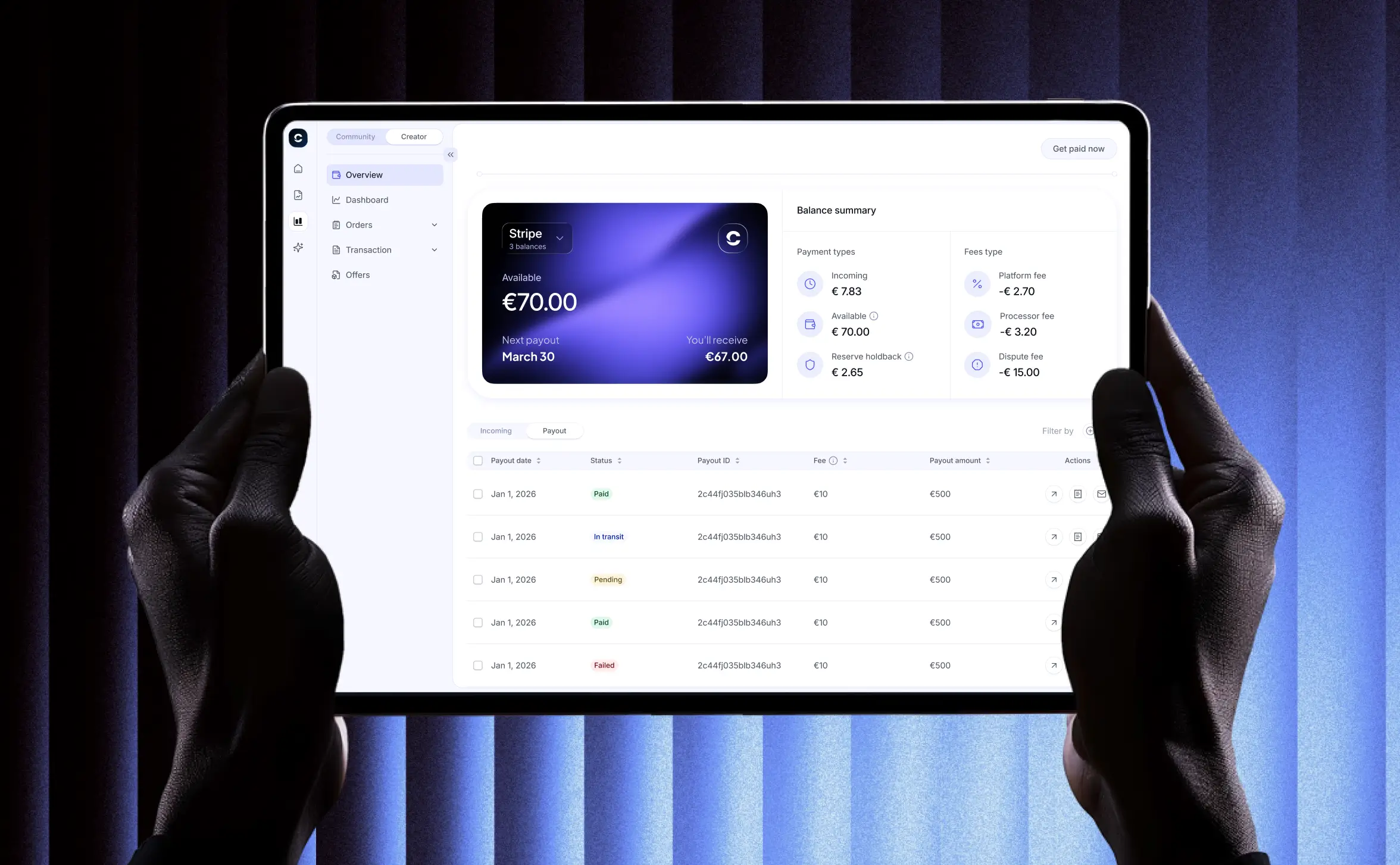

Your dashboard says $4,200. Your bank says $3,150 arrived, nine days after you expected it. Nobody told you where the difference went or why the wait. That's not a slow platform. That's an opaque one.
This guide follows the money from the sale to your account, explains the three reasons it stops on the way, shows you how to read a balance, and ends with the checklist for choosing a platform by how it pays you rather than by what it promises.
Here's what this guide covers, in the order the money moves:
How money moves from a sale to your bank
How fast platforms actually pay out, and why the number is always conditional
Why a payout is on hold: the three causes
How to read your balance
What a transparent payout looks like: the checklist
The money Flow
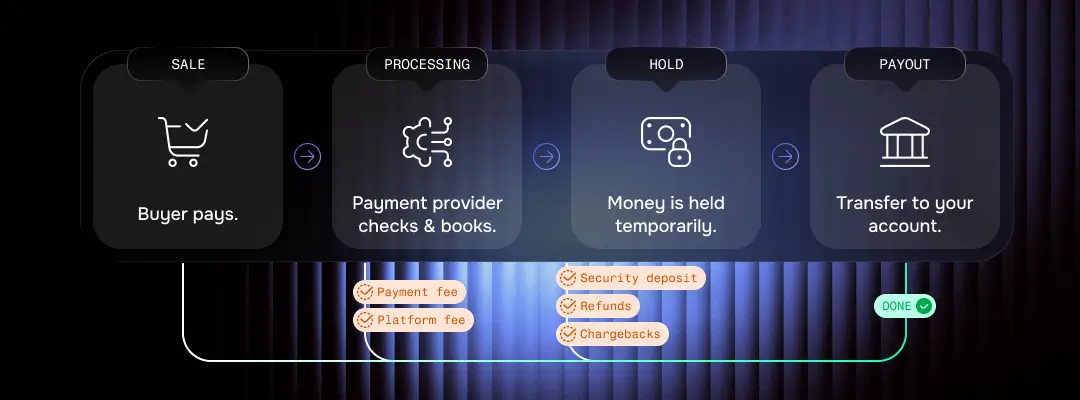
How does money move from a sale to your bank account?
In four steps. The buyer pays (sale). The processor verifies and captures the payment (processing). The platform holds the funds for a defined period against refunds and disputes (hold). Then it transfers your balance on a schedule (payout). Each step can add days, and only the first one is instant.
Here's where money leaves along the way. At processing, the card or payment fee comes off. At processing or at payout, depending on the platform, the platform fee comes off. Refunds come off whenever they happen, which can be after the money was already counted. Chargebacks come off later still, often with a fee attached.
So "I sold it on Monday" and "it's in my bank on Monday" are two different events with a gap between them. The gap isn't the problem. The problem is when you can't see what's happening inside it.
How fast do creator platforms actually pay out?
It depends on three things, not on the platform's marketing: whether your account is new, whether a reserve applies to you, and whether a review is open. Established accounts on major processors are typically paid on a rolling schedule every few business days. New accounts wait longer. Any dispute activity slows everything down.
The published numbers, with the conditions attached:
Stripe pays most established accounts on a rolling schedule every two business days, with some industries and account types placed on a seven-day schedule instead. The exact schedule is visible in the account's Payouts section.
First payouts on new accounts are held while identity and bank details clear: seven to fourteen days on Stripe, and seven to twenty-one days or more across sales channels in general, sometimes longer.
Some platforms batch payouts once a month regardless of processor speed.
Rolling reserves, where they apply, hold a percentage of every sale for thirty to ninety days after the transaction clears.
Read that list once more and notice what it means: no platform can honestly promise you a number, because the number depends on your account, your dispute rate and your volume. A platform that advertises "paid in 24 hours" is describing its best case for its most established sellers. Yours may be different, and you'll find out when your first payout doesn't arrive.
Stop asking how fast a platform pays. Ask whether you can see why it hasn't yet.
That's why this guide doesn't rank platforms by speed. It ranks them by whether you can plan around them.
Why is your payout on hold? The three causes
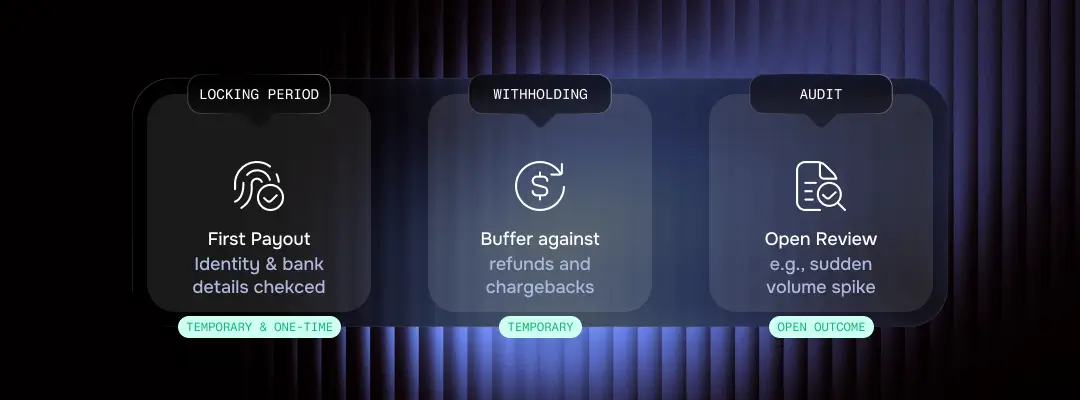
A first-payout hold, a rolling reserve, or a compliance flag. The first two are normal and end on a schedule. The third is open-ended and needs a conversation.
First-payout hold. One-off. New accounts wait while the processor verifies identity, business details and the bank account. It ends when verification does, usually within a couple of weeks. You can't waive it, but you can shorten it by having every document ready on day one: government ID, tax number, a live product page that clearly shows what you sell.
Rolling reserve. A percentage of each sale held back and released later, usually after thirty to ninety days. It's the platform's buffer against refunds and chargebacks. It applies to some sellers by default, to others after a spike in disputes or volume. As the DACH reference point, Digistore24 holds ten percent of each payout for sixty days as a security reserve. That's a normal practice, and a transparent platform states its reserve policy before you sign up rather than after your first short payout.
Compliance flag. An open review. Something triggered a closer look: a sudden jump in sales, a cluster of chargebacks, a product page that doesn't match the account, a payment pattern that looks unusual. There's no fixed release date because the review has to finish first.
How to tell them apart: a hold and a reserve have a date attached, or at least a defined period. A flag doesn't. If your platform can't tell you which of the three you're in, that's the problem, not the delay.
What raises your risk score, on any platform: a high dispute rate, a sudden volume spike, unverified account details, and a product page that doesn't say clearly what the buyer gets. The last one is the easiest to fix and the most often ignored.
Three reasons a payout is held
How do you read your balance?
A balance has at least three parts: available (can be paid out now), pending (sold, not yet cleared), and on hold or reserved (cleared, but held back). If your platform shows you one number, you can't plan, because you don't know which part of it is yours today.
The second thing a balance needs is a trail. Every fee, every refund, every chargeback should appear on the sale it belongs to, not as a monthly lump at the bottom. When sellers say "the numbers don't match," it's almost always a deduction that happened without a line item: a refund processed after the sale was counted, a chargeback fee, a reserve release that didn't show as a release.
Before you contact support about a mismatch, check three things: the refunds in the period, the reserve movements in the period, and the payout schedule you're on. Nine times out of ten the difference is sitting in one of those.
On COPE, every sale, fee and refund is recorded automatically as it happens. Every cent tracked. You see what's available and what's on hold, separately. You choose the payout schedule. And every payout arrives with a full breakdown of what's in it and an estimated arrival date. [VERIFY register wording for the arrival date field and the payout methods] What COPE doesn't do is promise you a speed. It shows you the date and the reason, which is the thing you can actually plan around.
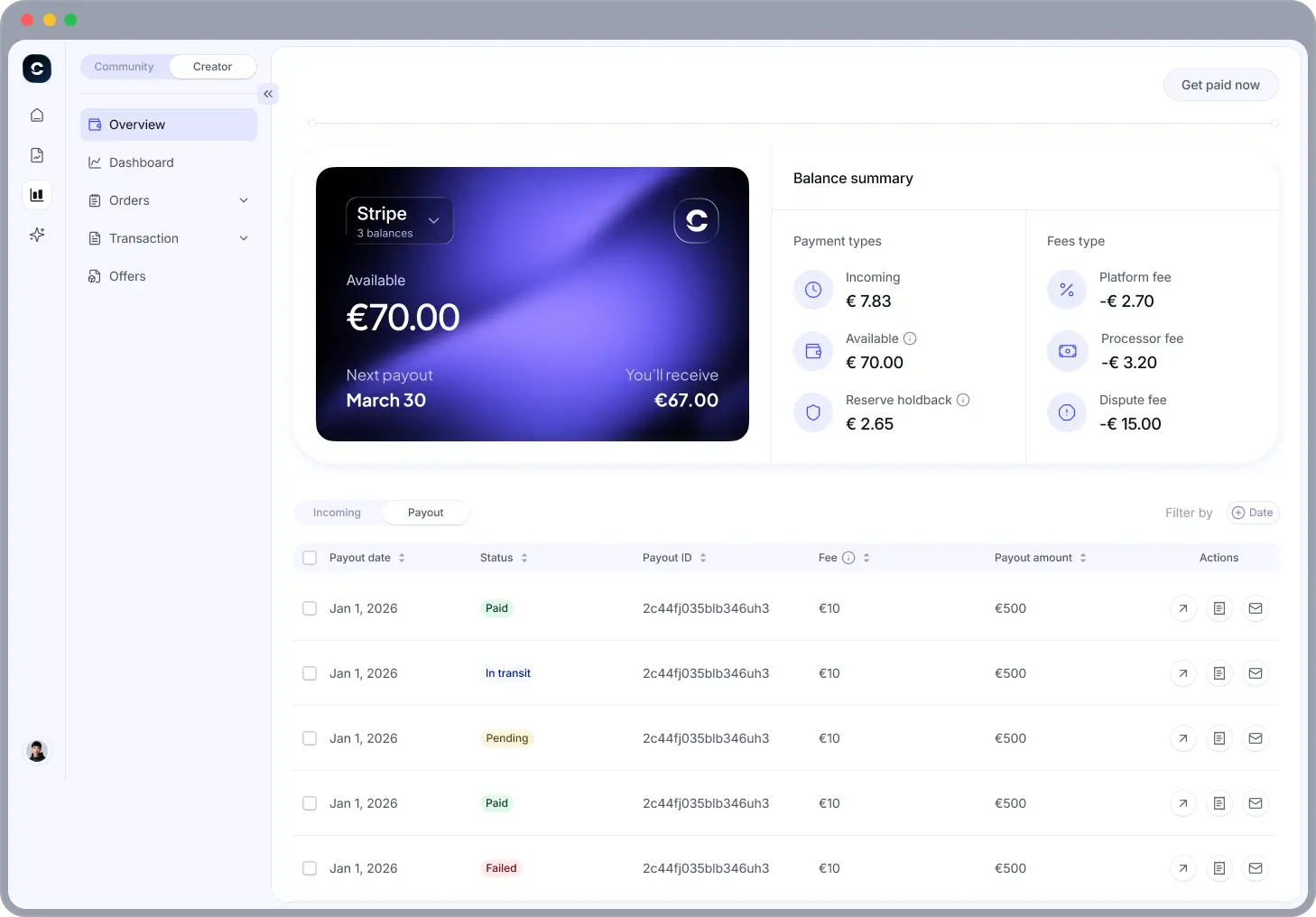
If you want to see that with your own numbers: set up your product and watch the first sale land in your balance. No monthly fee.
What should a transparent payout look like? The checklist
Four signals, all visible before you sign up: available and on hold shown separately, every fee and refund listed per sale, a payout schedule you choose, and an estimated arrival date on every payout. A fifth: a reserve policy stated up front, not discovered on your first short payout.
Turn them into five questions for any platform you're considering:
Does the balance show available, pending and on hold as separate numbers? One number means you're guessing.
Can I see every fee and refund on the sale it belongs to? Monthly lumps hide mistakes.
Do I choose the payout schedule, or does the platform? If you can't set it, you can't plan around it.
Does each payout come with a breakdown and an expected arrival date? Platforms that show an estimated date at the earnings screen report fewer "where's my money" tickets, because sellers stop guessing.
Is the reserve policy written down somewhere I can read before I sign up? If you have to ask support, it's not transparent.
Any platform that passes all five is one you can run a business on, whatever its speed. Any platform that fails two of them will surprise you, and the surprise will come on the month you can least afford it.
That's not a slow platform. That's an opaque one.
What do you do when a payout is late?
Five steps, in order:
Read the balance parts. Is the money pending, on hold, or available but not yet sent? Each means something different.
Look for a hold or reserve notice. Most platforms show one, buried. Find it before you email.
Gather the facts. Transaction IDs for the period, your payout method, the amount you expected, and the date of your last successful payout. Support teams triage on exactly these, and having them ready turns a week of back-and-forth into one reply.
Ask one specific question. "Is this a reserve, a hold, or a review, and what's the release date?" Not "where's my money."
Don't move volume elsewhere mid-review. Splitting sales across platforms during a compliance check reads as evasion and lengthens the review.
Do you owe tax on money that's still on hold?
That depends on your accounting method and your country, and it's a question for your accountant, not a platform. What a transparent platform gives you is the record: every sale with its date and its fee, so the answer is calculable from your own data rather than from a guess.
Frequently asked questions
How fast do creator payment platforms actually pay out earnings? Established accounts on major processors are paid on a rolling schedule every few business days; new accounts wait seven to twenty-one days or more for a first payout; rolling reserves hold part of each sale for thirty to ninety days. No platform can honestly promise a single number. COPE shows an estimated arrival date on every payout instead of promising a speed.
Which platform has a transparent payout schedule and a clear balance overview? Look for four signals: available and on hold shown separately, every fee and refund per sale, a schedule you choose, and an estimated arrival date per payout. COPE shows all four, with every sale, fee and refund tracked as it happens.
What is a rolling reserve? A percentage of each sale that the platform holds back for a period, typically thirty to ninety days, as a buffer against refunds and chargebacks. It's released on a rolling basis as each transaction ages out.
Why did my platform freeze my payout? One of three things: a first-payout hold while your account is verified, a rolling reserve applied to your sales, or a compliance review triggered by a spike in disputes, volume or an unclear product page. Ask which one, and ask for the release date.
What's the difference between pending, available and on hold? Pending is sold but not yet cleared. Available is cleared and can be paid out now. On hold is cleared but held back, by a reserve or a review.
Why doesn't my payout match my sales? Usually a refund or chargeback processed after the sale was counted, a fee without a line item, or a reserve movement. Check those three before contacting support.
Can I choose when I get paid out? On some platforms yes, on others the schedule is fixed. On COPE you choose the payout schedule, and each payout comes with a breakdown and an estimated arrival date.
What should I ask support when a payout is late? Whether it's a hold, a reserve or a review, and what the release date is. Have your transaction IDs, payout method, expected amount and last successful payout date ready.
Getting paid as a digital seller isn't about the fastest platform. It's about the one where you can see, on any day, what's yours, what's held, why, and when it arrives.
COPE records every sale, fee and refund as it happens, shows you what's available and what's on hold, lets you choose your payout schedule, and sends every payout with a breakdown and an estimated arrival date. Set up your product and see the first sale land in your balance.
Schedules, hold periods and reserve practices are from the processors' and platforms' own pages and the sources below, as of September 2026, and change. This article isn't financial or tax advice.
Article written by
Michelle Habenicht