Payments
A rolling reserve holds back part of each sale for a while. Here is how it works, what decides it and how to read your balance.

A rolling reserve is a share of each sale that your payment provider holds back for a set period. It covers possible refunds and chargebacks. The money is still yours. Once the period ends, it is released bit by bit while newer sales take its place.
Your dashboard shows a strong month. Your bank account shows less. The gap often comes down to one word nobody explains well: reserve.
Here is what you will learn:
what a rolling reserve is
why payment providers hold money back
which types of reserves exist
what decides whether you get one
how to read your balance with a reserve
how to shrink a reserve
What is a rolling reserve?
A rolling reserve is a safety hold that moves with your revenue. A share of every sale stays on hold for a fixed time. When that time is up, the share is released. A share of the next sale then goes on hold.
That is why it is called rolling. Sell more and the reserve grows. Sell less and it shrinks.
The key point: the money is still yours. You just get it later.
Why do payment providers hold money back?
Because a payment can still come back after the purchase. Buyers can ask for a refund or dispute the charge with their bank, which is called a chargeback. That can happen weeks after the sale.
If your balance has already been paid out by then, there is nothing left to cover the refund. The reserve makes sure the money is there for those cases.
A reserve says nothing about the quality of your offer. It balances a risk that comes with every online sale. According to the payment provider Checkout.com (2023), most businesses never need a reserve, and no law requires one.
What types of reserves are there?
There are four common forms. This is how Stripe describes them in its guide to rolling reserves:
Type | How it works | Grows with your revenue? |
|---|---|---|
Rolling reserve | A share of each sale is held for a while, then released on a running basis | Yes |
Fixed reserve | A set amount is held until a deadline or condition is met | No |
Capped reserve | A share is held until a ceiling is reached | Up to the ceiling |
Upfront reserve | An amount is set aside before the first payments run | No |
What decides whether you get a reserve?
The risk of your account as your provider sees it. Typical reasons include:
your account is new and has no sales history yet
your refund or chargeback rate is high
your revenue jumps sharply, for example during a launch
there is a long gap between purchase and delivery, like a coaching program that starts months later
you sell in an industry where disputes are more common
At COPE we look at similar factors: how long your account has existed, how many refunds and chargebacks it has, what kind of product you sell, which payment methods your buyers use and how far your verification has progressed.
How do you read your balance with a reserve?
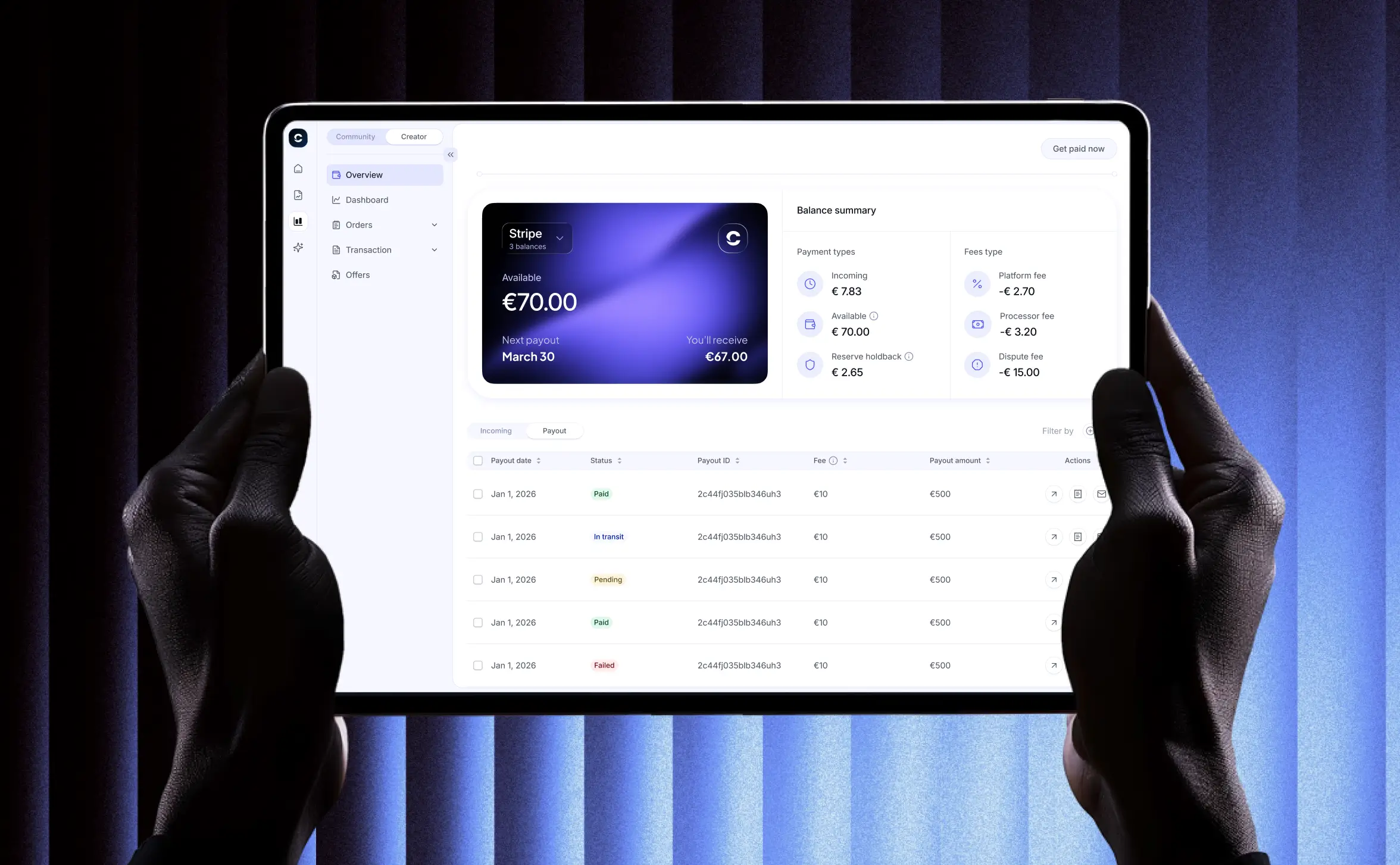
Split your balance into three buckets:
Available: money that reaches you with your next payout.
Incoming: payments that are still being processed. You see the date each amount becomes available.
Reserve: the part held back as a safety buffer. You see the amount and the date it is released.
The available bucket is the one to plan with.
Use your available balance when you budget for expenses, ad spend or tax savings.
On COPE you find exactly these three buckets in the balance summary of your account. Every payout comes with a breakdown of sales, fees and refunds. And you choose whether we pay out weekly, every two weeks or monthly.

How do you shrink a reserve?
With few disputes and a clean history. These four levers help:
Describe your offer precisely. What does the buyer get, when and in what format? Unclear expectations lead to refunds.
Reply quickly to questions and complaints. A refund you give yourself usually costs you less than a chargeback through the bank. Our guide on reducing chargebacks for online courses goes deeper.
Send a clear invoice with every purchase. That way buyers recognize the charge on their statement. On COPE the invoice goes out automatically.
Give high prices some structure. Buyers who can pay in installments do not have to cover everything at once. Our article on payment plans for high-ticket coaching shows how.
As your history grows, providers usually adjust the reserve.
How we handle reserves at COPE
We decide whether a reserve is needed based on the risk of each individual account. If one applies to you, you see it in your account along with the amount and the date it is released.
We adjust the reserve when your risk changes. Once the risks have passed, we release it. In the meantime the money sits with our payment processors, separate from our own funds.
How long a payout takes overall depends on several things. We explain that in how payouts on creator platforms really work.
FAQ
Is a rolling reserve normal?
Yes. Payment providers use them often, especially for new accounts and in industries with many disputes. Many sellers never have one. No law requires it.
Do I get the money from the reserve back?
Yes. The money belongs to you and is released after the hold period. Only refunds or chargebacks that came in during that time are deducted.
How long is money held in a rolling reserve?
Each provider sets its own period. It depends on your risk and on how long buyers can dispute a payment with their bank. On COPE you see in your account how large your reserve is and when it is released.
Why is more held back for me than for others?
Because the reserve is based on your account. What matters is the age of your account, your refunds and chargebacks, the type of product you sell and sudden revenue spikes.
Can I reduce a reserve?
Often, yes. With few refunds, few chargebacks and a longer clean history, providers usually adjust the reserve.
What is the difference between a reserve and a payout hold?
A payout hold applies to every payment until it is processed and ready to pay out. A reserve also keeps a share on hold for longer to cover a specific risk.
Conclusion
A rolling reserve first looks like missing money. Once you understand it, you plan with your available balance and keep refunds low. Over time the reserve can then get smaller.
On COPE you always see what is available and what is still waiting. And you only pay when you sell. Start free on COPE and take a calm look around your account.

Article written by
Michelle Habenicht