Wachstum
Two ways to offer payment plans on a coaching program, one of them without carrying the default risk. Plus the five-step close that takes payment during the call.

This guide walks you through the setup in five steps: which payment options a high-ticket checkout needs, how the two payment-plan models work with a $5,000 example, how closer teams take payment on the call, how to stop checkout abandonment, and how to plan cash flow when money arrives in pieces.
Here are the 5 steps to a payment setup that closes high-ticket offers:
Choose the payment options your clients actually use
Offer a payment plan: self-financed or financed
Take the payment on the call, with a link instead of card numbers
Fix the five things that make high-ticket buyers abandon checkout
Plan cash flow around when money lands, not when contracts are signed
Which payment options does a high-ticket coaching checkout need?
Card, a financed payment plan, and one bank-based option. For clients outside the US, card is usually the only universal method. For US clients, the payment plan is what turns "I can't afford it right now" into a yes.
Here's how the options line up for a coaching business:
Payment option | Who uses it | Risk to you | When to offer |
Credit or debit card | Everyone, and the only universal option for international clients | Chargebacks, reduced by 3-D Secure and clear delivery records | Always |
Financed payment plan (buy now pay later) | Buyers of offers from a few hundred dollars up | None, the provider carries credit and fraud risk | Any offer above roughly $300 |
Bank transfer or ACH | US clients paying larger amounts, some businesses | Payment arrives late or not at all, access has to be granted by hand | As a fallback, not a default |
PayPal | Buyers who trust the brand more than a card form | Buyer protection can be used against you, higher fee | Depends on your audience |
Wire | Corporate clients | Slow, manual | B2B only |
The pattern worth noticing: the option that does the most for high-ticket conversion is the one that carries no risk for you. That's the whole article in one row.
On COPE, your client sees the checkout in their own language (nine are supported) and chooses between card payment and several buy now pay later options built in. Prices can be set in USD and EUR.
The deal didn't die on price. It died on the payment step.
How do I offer instalment plans on a high-ticket coaching programme?
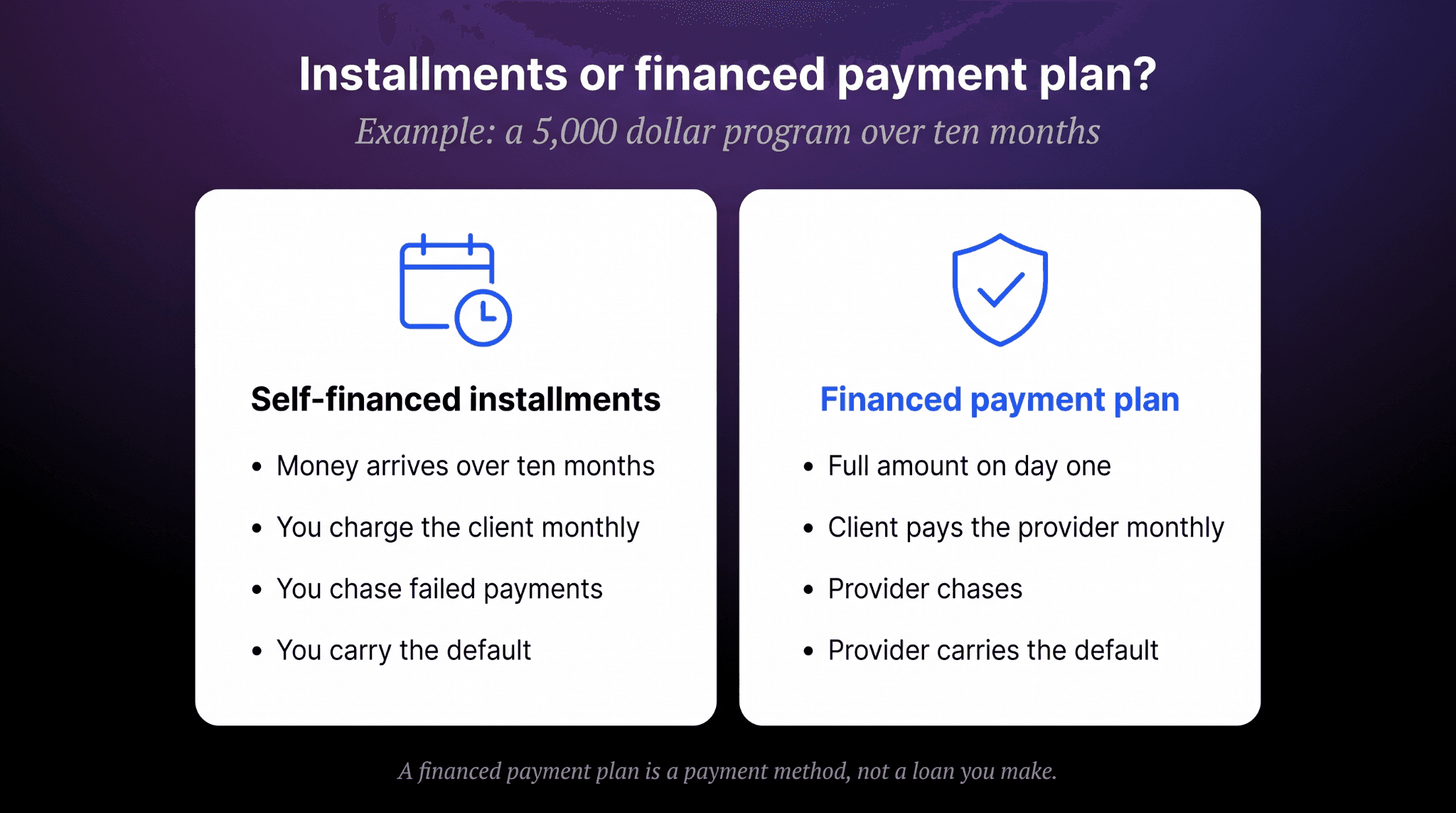
Two ways, and they both get called "payment plans." Self-financed installments: you split the price, charge the client monthly from your own account, and handle failed payments and default yourself. Financed payment plans: a provider approves the client at checkout, pays you the full amount on day one, and collects the installments from the client.
Most coaches mean the first one when they say "I offer payment plans." A $5,000 program becomes ten payments of $500 through their processor, and they hope. Run it through once.
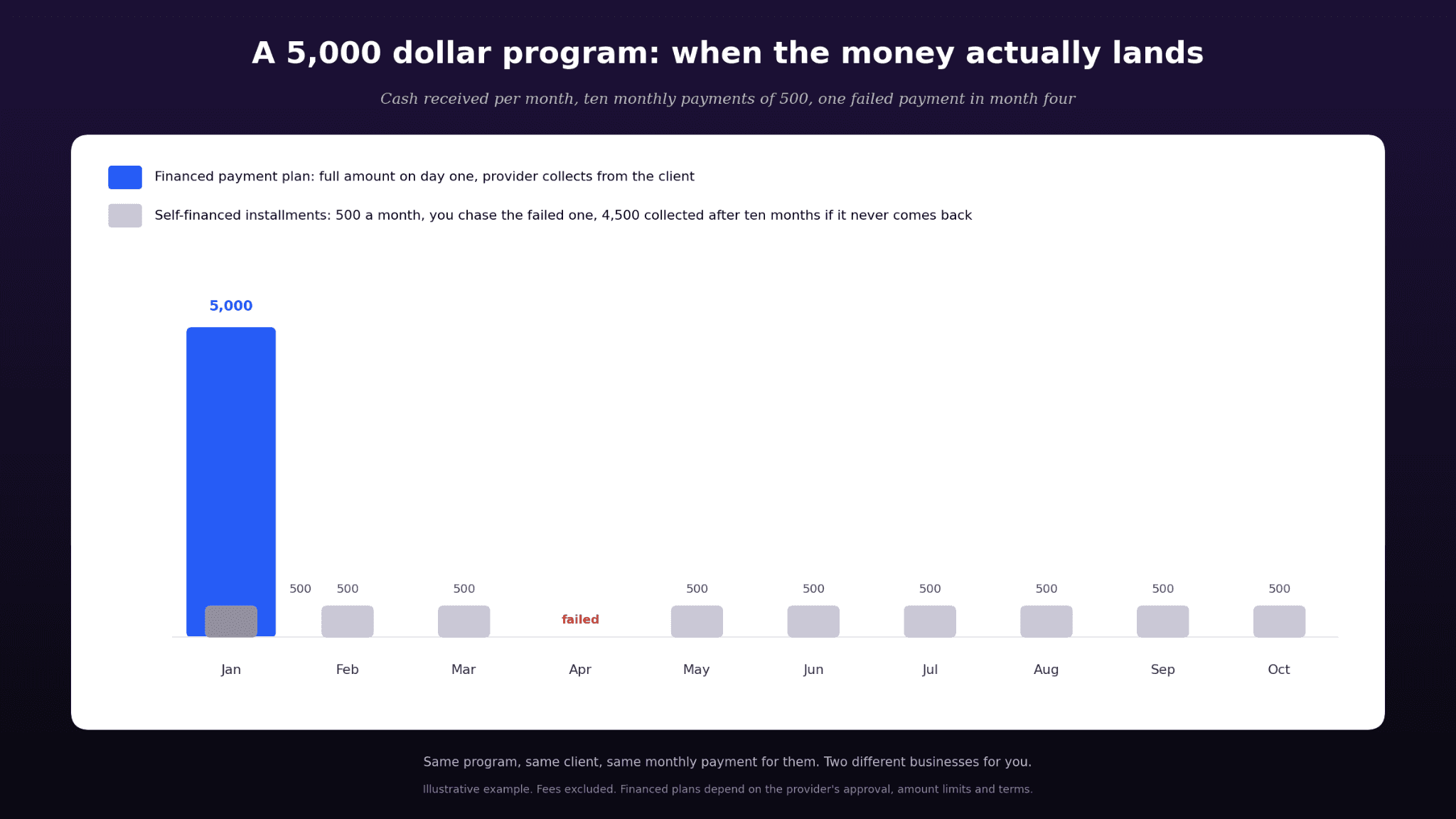
Self-financed, $5,000 over ten months. The client starts in January. You have $500 in January, $1,000 by February, and the full amount in October. Your costs for the program, your time, the calls, the material, start in January. In April, the card fails. Now you're writing dunning emails, deciding whether to cut access, and in the worst case you've delivered ten months of coaching for $1,500. You're the lender. Without underwriting, without collections, without the margin a lender charges for both.
Financed, same program. The client picks "pay over time" at checkout. The provider runs a credit check in seconds and approves them. You receive the $5,000 on day one, minus fees. The client pays the provider monthly. If they stop, that's the provider's problem. This is how mainstream providers work: Affirm, for example, finances purchases up to $30,000 over terms up to 36 months, and the merchant is paid in full upfront.
Offering a payment plan usually means becoming a lender with no underwriting.
To the client, both feel the same: a monthly payment. To you, they're different businesses. One ties up capital and attention. The other is a payment method, like a card, with better conversion on higher prices.
Financed plans have limits, and it's worth knowing them before a call. Providers run a credit check, not every client qualifies for every term, and there are caps. For offers above the cap, or for a client who gets declined, a self-financed plan is still a legitimate tool.
Do it properly then: a signed agreement with the total amount, the schedule, and an acceleration clause that makes the full balance due if two consecutive payments fail. Gate delivery to payments if your program allows it, so you're never working for free.
On COPE, it works like this. Your client lands on the checkout, sees card payment next to several buy now pay later options, picks a plan and completes the purchase. You're paid in full on day one.
The invoice is generated with the sale, with the right tax for the client's country, and the client is inside the program. Which plans a client sees depends on the amount and their country, not everyone qualifies for every term.
If you want to see how that looks for your program: set up your offer and open the checkout with payment plans. It takes a few minutes and there's no monthly fee.
How do closer teams take payment on the call?
With a payment link sent during the call that the client completes on their own device, including the payment plan option. Never card numbers over the phone.
Reading card numbers on a call fails twice. Once on compliance: you're holding data with strict rules attached, and the client knows it. Once on trust: someone typing their own card into a page with a lock icon feels in control. Someone dictating it to a stranger doesn't. The link converts better because the client keeps the wheel.
The five-step close:
Agree on the program and the price. Custom prices are fine, this is where closers earn their keep.
Send the payment link while you're still talking, by text, email or Zoom chat.
The client opens it, sees the price and the payment options, including the plan.
They pay. You see the confirmation.
Access is live. When you hang up, you actually won a new client (not just an “I’ll get back to you…”)
The difference from "I'll send you the invoice after": seconds between yes and paid, instead of days. Days are where deals die.
If your closer isn't the coach, the setup has to let them set a price per call without the coach approving each one, and it has to carry the payment plan inside the same link. Otherwise the closer sends the link, the client sees full price only, and you're back to "let me think about it."
On COPE this is called phone offers. The closer sets the price and terms on the call, sends the link, and the client pays before you hang up. Payment plans are available in the link the same way they are in the normal checkout. Invoice and access run like any other sale.
Running a closer team and want to see how this fits your process? Book a call and we'll walk through it with your offers.
How do I reduce checkout abandonment when selling high-ticket coaching?
Show the monthly price next to the full price before checkout, make the payment plan a primary option rather than a hidden one, keep the checkout to one page, close the gap between the call and the payment, and deliver access instantly.
Five fixes, and why each one works:
Show "as low as $X per month" on the offer page. The payment plan shouldn't be a surprise on the final screen. A client who sees $417 a month next to $5,000 has already done the math before they click.
Make the plan a primary option. Not a small link under the pay button. Two equal choices: pay in full, pay over time.
One page. Every extra step on a $5,000 checkout is a place to think twice. Name, email, payment, done.
No gap between yes and pay. Covered above. The link goes out during the call.
Instant access. The moment the payment lands, the client is inside. That's the strongest refund prevention there is, because the program has already started.
On COPE, the checkout is one page, payment plans sit next to card payment, and the client is enrolled the moment the payment lands.
How do I plan cash flow with payment plans?
If you finance the plan yourself, plan on cash received, not on contracts signed, and budget for at least one default per cohort. If a provider finances it, the full amount arrives on day one and you plan with what you have.
A simple rule for self-financed plans: count what actually landed this month, and keep a buffer. Ten clients on ten-month plans aren't ten programs of revenue. They're ten first payments and ninety open ones. One default a year isn't bad luck, it's the base rate.
Under a financed plan the question disappears. The sale is one purchase, one invoice for the full amount, money on day one. The provider's relationship with the client is theirs.
What happens when a payment fails?
Card, paid in full. The client can dispute with their bank. With 3-D Secure and clean delivery records (access logs, session notes, messages) you win most disputes. Without them, you lose most.
Self-financed installment. Everything is yours: the reminder, the decision about access, collections or write-off. This is the cost that never shows up in the "3-pay" pricing table.
Financed payment plan. The provider paid you on day one. If the client stops paying them, that's between the client and the provider. You usually don't hear about it.
Common mistakes with payment plans in coaching
1. Building the plan yourself without a contract. An email thread isn't an agreement. If you self-finance, sign something with an acceleration clause.
2. Reading card numbers on the call. Compliance risk, trust risk, worse conversion than a link.
3. Hiding the monthly price until checkout. The client should know the monthly number before they get on the call, not after.
4. Letting days pass between the call and the link. Send it while you're talking.
5. Pricing in the wrong currency. A client in Germany wants to see euros. Set prices per currency where you can.
Frequently asked questions
How do I offer instalment plans on a high ticket coaching programme? Two ways. Self-financed: split the price and charge monthly from your own account, carrying failed payments and default yourself, ideally with a signed agreement. Financed: offer a buy now pay later option at checkout, the provider pays you in full on day one and collects from the client. On COPE, several buy now pay later options are built in and you're paid in full on day one.
I'm selling a $5,000 programme online with monthly payment plans, what payment setup do I need? A checkout that offers card and a financed payment plan side by side, shows the monthly price before checkout, delivers access instantly, and generates the invoice with the sale. If you sell by phone, a payment link you can send during the call, with the plan inside it.
Which checkout supports buy now pay later for online courses? Payment processors that integrate BNPL providers, and sales platforms with financed payment plans built in. On COPE, several buy now pay later options are built into the checkout, and the seller is paid in full upfront on every one.
What tools does a closer team need to sell coaching programmes by phone? A way to set a custom price per call, a payment link that carries the payment plan option, and instant confirmation so the closer knows the deal is done before hanging up. On COPE that's phone offers.
How do I reduce checkout abandonment when selling high ticket coaching online? Show the monthly price on the offer page, make the payment plan a primary option, keep the checkout to one page, send the payment link during the call instead of after, and give instant access.
Can I use Affirm or Klarna for a $15,000 coaching program? Usually not for the full amount. Financed providers have caps and credit checks, and $15,000 sits above many of them. Options: a down payment through the provider and the rest self-financed with a contract, or splitting the offer into phases.
What's the difference between an installment plan and buy now pay later? An installment plan you finance yourself: you charge monthly and carry the risk. Buy now pay later is financed by a provider: you're paid in full on day one, the client pays the provider, the provider carries the risk.
What happens if a client stops paying a payment plan? On a self-financed plan, you handle reminders, access and collections. On a financed plan, the provider already paid you and handles the client.
A payment setup that closes high-ticket offers has three parts: a payment plan that doesn't make you the lender, a link that takes the payment on the call, and a checkout that gives access the moment the money lands.
COPE gives you the checkout in nine languages, several buy now pay later options with the full amount paid to you on day one, phone offers for the close on the call, and the invoice generated with the sale. Set up your first offer and take a payment today
Provider limits and terms are from the providers' own pages as of September 2026 and change. This article isn't financial or legal advice.
Verfasst von
Michelle Habenicht