Wachstum
Two ways to offer payment plans on a coaching program, one of them without carrying the default risk. Plus the five-step close that takes payment during the call.


This guide walks you through the setup in five steps, from choosing the offer to the rules that keep the program clean. It also answers the question that stops most programs before they start: where the affiliates come from.
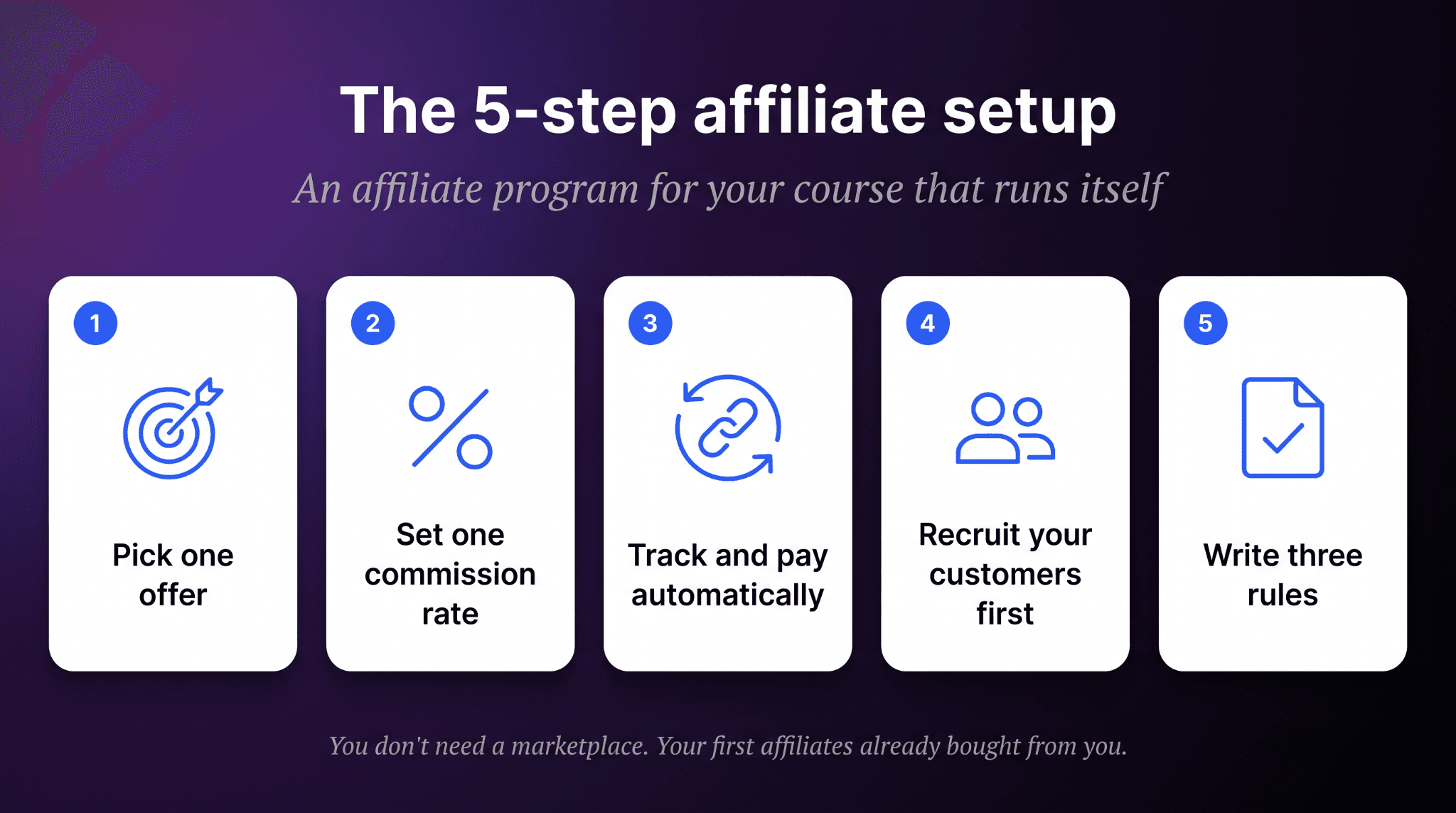
Here are the 5 steps to an affiliate program that runs itself:
Choose the one offer you open to affiliates first
Set one commission rate, not a tier system
Track sales and pay commissions automatically, with refunds handled
Recruit affiliates, starting with your customers
Write the three rules every program needs
Which offer should you open to affiliates first?
The one with the clearest result and the fewest refunds. Affiliates sell outcomes, not curricula, and a refund-heavy offer costs you twice: once in the refund, once in the commission you have to claw back.
Don't open the whole catalog. One offer with a clear promise ("finish your first client website in 30 days") gives affiliates one link and one story to tell. If you have several products, start with the one that gets the best reviews and the fewest "this wasn't what I expected" emails. You can add the rest once the first one works.
Check the margin before you go further. If the offer is priced at $497 and you plan to pay 30 percent, you need to be fine with keeping the rest minus fees on every affiliate sale. For a digital product with no cost of goods, that's usually easy. For a program with heavy 1:1 delivery, run the numbers first.
What commission should you pay affiliates for an online course?
Digital courses commonly pay between 20 and 50 percent, because there's no cost of goods behind each sale. Start with one rate around 30 percent and raise it for the affiliates who actually sell, instead of building a tier system nobody understands.
Here's the math on a $497 course at 30 percent: the affiliate earns $149.10 per sale. You keep the rest, minus your platform and payment fees. If the affiliate brings a buyer you'd never have reached, that's a customer for roughly the cost of a good ad, with the difference that you only paid because a sale happened.
Three decisions inside the rate:
One rate, not seventeen. New affiliates get X percent, top performers get Y percent. That's the whole structure. Tiers by volume, audience size and moon phase make the program harder to explain than to sell. Teachery makes the same point in its course affiliate guide, and it's right.
First sale only, or recurring? For a one-time course, the commission is on the sale. If you sell memberships, decide whether affiliates earn on renewals. On COPE, there are no recurring memberships today, so the commission is on the sale.
How long does the link count? The cookie window. Longer windows suit higher-priced courses where buyers take weeks to decide. Thirty days is a common middle. [VERIFY: COPE cookie window and whether rates can be set per product]
A commission that reverses on refund is the difference between a program and a liability.
How do you track sales and pay commissions automatically?
Use a platform where the affiliate link, the sale, the commission and the payout live in one system, and where a refund reverses the commission on its own. Spreadsheets and manual mass payments are where affiliate programs die.
"Automatic" has to mean four things, or it isn't automatic:
Every affiliate gets a unique link, and a purchase through it is attributed to them at checkout.
The commission is frozen at the moment of the sale, at the rate that applied then.
If the buyer refunds, the commission reverses on its own. No clawback emails, no "please return the $149".
Payouts run on a schedule without you exporting a report and pasting it into a payment tool.
Here's what goes wrong when any of the four is manual. You pay a commission on a sale that gets refunded two weeks later, and now you're asking an affiliate for money back. You pay late because the monthly export slipped, and your best affiliate quietly stops promoting. Two affiliates claim the same sale, and you have no record that settles it. Most guides tell you to "hold commissions until the refund window closes," which fixes the first problem by creating the second.
On COPE, the affiliate program works like this. You create an affiliate, they get their link. A buyer purchases through it, and the commission is frozen at that sale. If the buyer refunds, the commission reverses automatically. COPE tracks every sale and pays your affiliates out. The books always match. What you bring is the affiliates themselves: there's no marketplace, and there are no sub-affiliate tiers, which keeps the program simple to explain and clean to run.
If you want to see what that looks like for your course: set up your offer and create your first affiliate. No monthly fee (and the commission logic is built in).
Where do you find affiliates to promote your digital product?
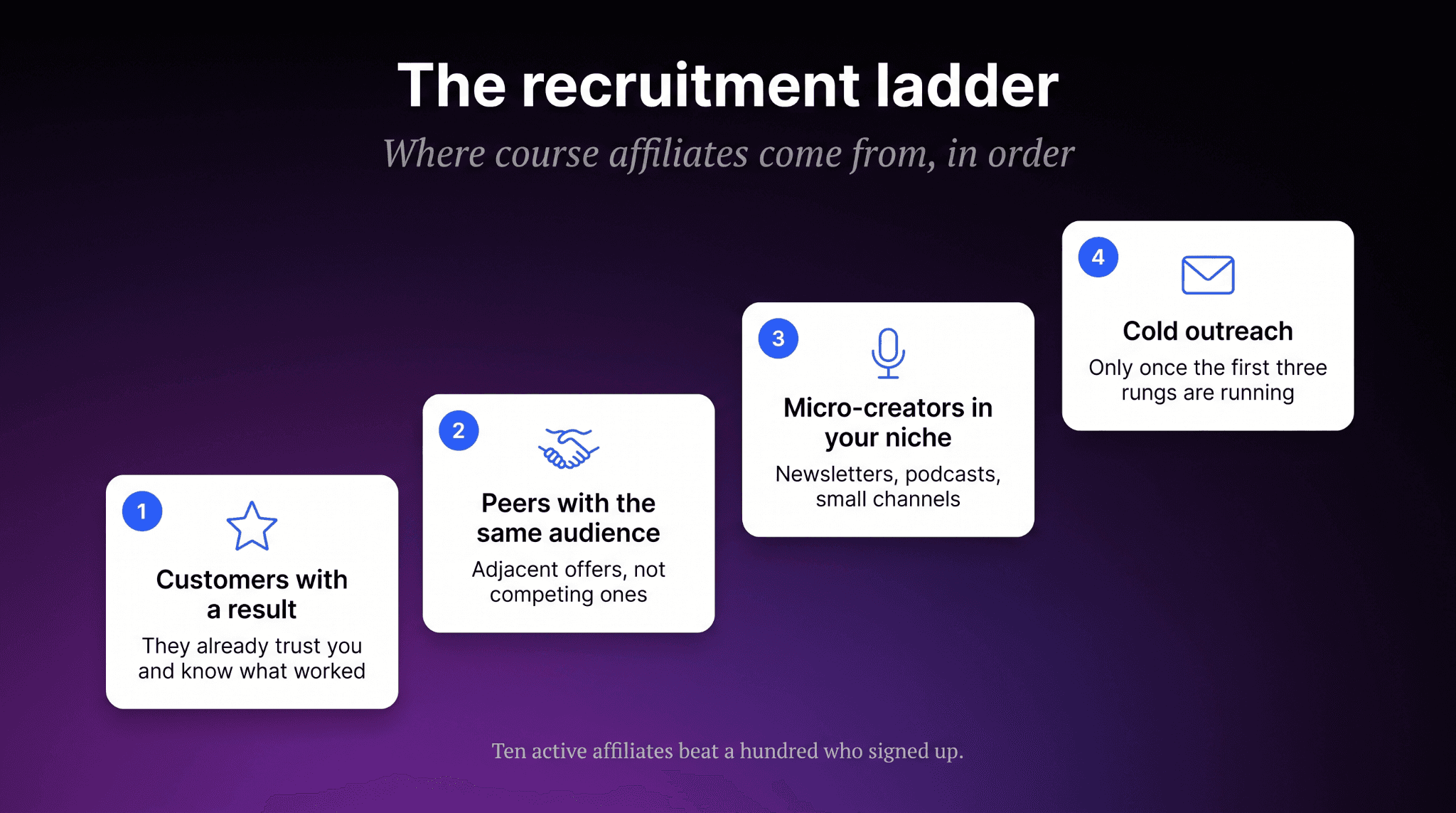
In your customer list first. People who bought your course, finished it and got a result are your most credible affiliates and the cheapest to recruit. Then peers who sell to the same audience. Then micro-creators in your niche. Cold outreach comes last, and it comes with a script.
Your best affiliates aren't on a marketplace. They're in your customer list.
The recruitment ladder, one rung at a time:
Rung 1: customers with a result. Email the people who finished. One line: "You got X out of the course. If you know anyone who'd want the same, here's a link that pays you 30 percent when they buy." They already trust you, they're specific about what worked, and they talk to people like themselves.
Rung 2: peers with the same audience. Coaches and creators who sell something adjacent, not competing. A copywriting coach and a web design course share an audience. Offer the same commission and a swap: you promote theirs too.
Rung 3: micro-creators in your niche. Newsletter writers, podcast hosts and YouTubers with a few thousand engaged followers. They rarely have a course of their own, and a 30 percent commission on a $497 product is real money to them.
Rung 4: cold outreach. Only once rungs one to three are running. A short message that names the result, the commission and one reason it fits their audience. No pitch decks.
Two things that don't work at the start: putting an "apply to be an affiliate" form on your site and waiting, and signing up a hundred affiliates who never post a link. Ten active affiliates beat a hundred who signed up. Recruit each one by hand at the beginning.
Give every affiliate three things: one link, one page of swipe copy (two emails, three social posts, one story they can tell), and a reason to post this month (a launch, a deadline, a bonus).
This is also why COPE doesn't ship an affiliate marketplace. The affiliates who move a course business aren't strangers browsing a catalog. They're people who already know you.
Which rules does an affiliate program need?
Three: no bidding on your brand name in search ads, no coupon or cashback sites unless you've allowed them, and disclosure of the affiliate relationship where the law requires it.
No brand bidding. An affiliate who runs search ads on your name isn't bringing you customers, they're intercepting the ones already looking for you and charging you a commission for it.
No coupon sites by default. A coupon site that shows up at checkout with a code captures the sale from whoever actually did the selling. Allow them only if you want them.
Disclosure. In the US, the FTC expects affiliates to disclose that they earn from the link. The EU has equivalent rules. Put one sentence about it in your affiliate terms and one example line in the swipe copy.
One more line for the terms: no self-referrals. An affiliate buying through their own link isn't a sale, it's a discount they gave themselves.
Affiliate program or affiliate marketplace: which one do you need?
A marketplace brings affiliates you don't know, at the price of competition and less control. Your own program brings affiliates you chose, at the price of recruiting them. Most course creators are better off with their own program first.
Marketplaces like Digistore24, ClickBank or Whop list your offer where affiliates browse. That can produce volume, and for some info-product niches it's the main channel. It also means your course sits next to dozens of similar ones, the affiliates who pick it up don't know your audience, and the terms are the marketplace's.
Your own program is smaller and yours. The affiliates came from your customers and your peers, they promote because they believe the offer, and you set the rules. For a coach or course creator with a real customer base, that's the channel that compounds.
You can add a marketplace later. Starting there usually means starting with strangers.
Common mistakes with course affiliate programs
1. Paying on refunded sales. Fix it with a system that reverses commissions automatically, not with manual holds.
2. Seventeen commission tiers. One rate, raised for top performers.
3. Opening the whole catalog. One offer with a clear result first.
4. Waiting for applications. Recruit the first ten by hand.
5. No swipe copy. An affiliate with a link and nothing to say posts nothing.
6. No rules. Brand bidding and coupon sites will find you if you don't say no in advance.
Frequently asked questions
How do I set up an affiliate program for my online course with automatic commission payouts? Pick one offer, set one commission rate, and use a platform where affiliate links, sales, commissions and payouts live in one system with commissions that reverse on refunds. Recruit your first affiliates from your customers, and write three rules. On COPE, the affiliate program is built in: commissions freeze at the sale, reverse on refund, and COPE tracks every sale and pays affiliates out.
Where can I find affiliates to promote my digital product? Start with customers who got a result, then peers who sell to the same audience, then micro-creators in your niche, then cold outreach. You don't need a marketplace to start.
What commission should I pay affiliates for a course? Digital courses commonly pay 20 to 50 percent. Start around 30 percent with one rate, and raise it for the affiliates who actually sell.
What happens to the commission if a customer refunds? On a well-built program, the commission reverses automatically. On a manual program, you're emailing the affiliate for the money back. On COPE, commissions are frozen at the sale and reversed on refund.
Do I need an affiliate marketplace? Not to start. Your own program with affiliates from your customer base usually outperforms strangers from a marketplace for a course business. You can add a marketplace later if volume is the goal.
How many affiliates do I need to start? Ten active affiliates beat a hundred who signed up. Recruit the first ten by hand.
Can affiliates recruit sub-affiliates? Some platforms allow multi-tier programs. On COPE they don't exist, which keeps the program single-tier: one affiliate, one link, one commission. Simpler to explain, easier to keep clean.
How do I stop affiliates from bidding on my brand name? Write it into your affiliate terms as a rule that ends the partnership, and check your brand name in search ads once a month.
An affiliate program for a course is one offer, one rate, one system that pays and reverses on its own, and ten people who already know your work. Everything else is scaling.
COPE gives you the affiliate program built in: links, commissions frozen at the sale, reversed on refund, tracked and paid out, with no monthly fee. Set up your offer and create your first affiliate today
Commission ranges and program practices are drawn from the sources listed below as of September 2026. This article isn't legal advice on disclosure rules.
Verfasst von
Michelle Habenicht