Wachstum
Five steps to a course community buyers actually use: one login, one purpose, the first 90 days, three rituals that run without you, and the nudge that brings quiet members back.


You added a Discord. Forty people bought the course. Eleven joined. Four posted. That's not a community problem. It's a second-login problem.
This guide walks you through the setup in five steps, from the one decision that determines whether buyers show up at all, to the rituals that keep the room alive when you're not in it.
Here are the 5 steps to a course community buyers actually use:
Deliver course and community from the same purchase and the same login
Give the community one purpose the course alone can't deliver
Run the first 90 days on a weekly rhythm
Build three rituals that keep it alive without you posting daily
Bring quiet members back, and lead finishers to the next purchase
How do you deliver a course and a paid community from the same login?
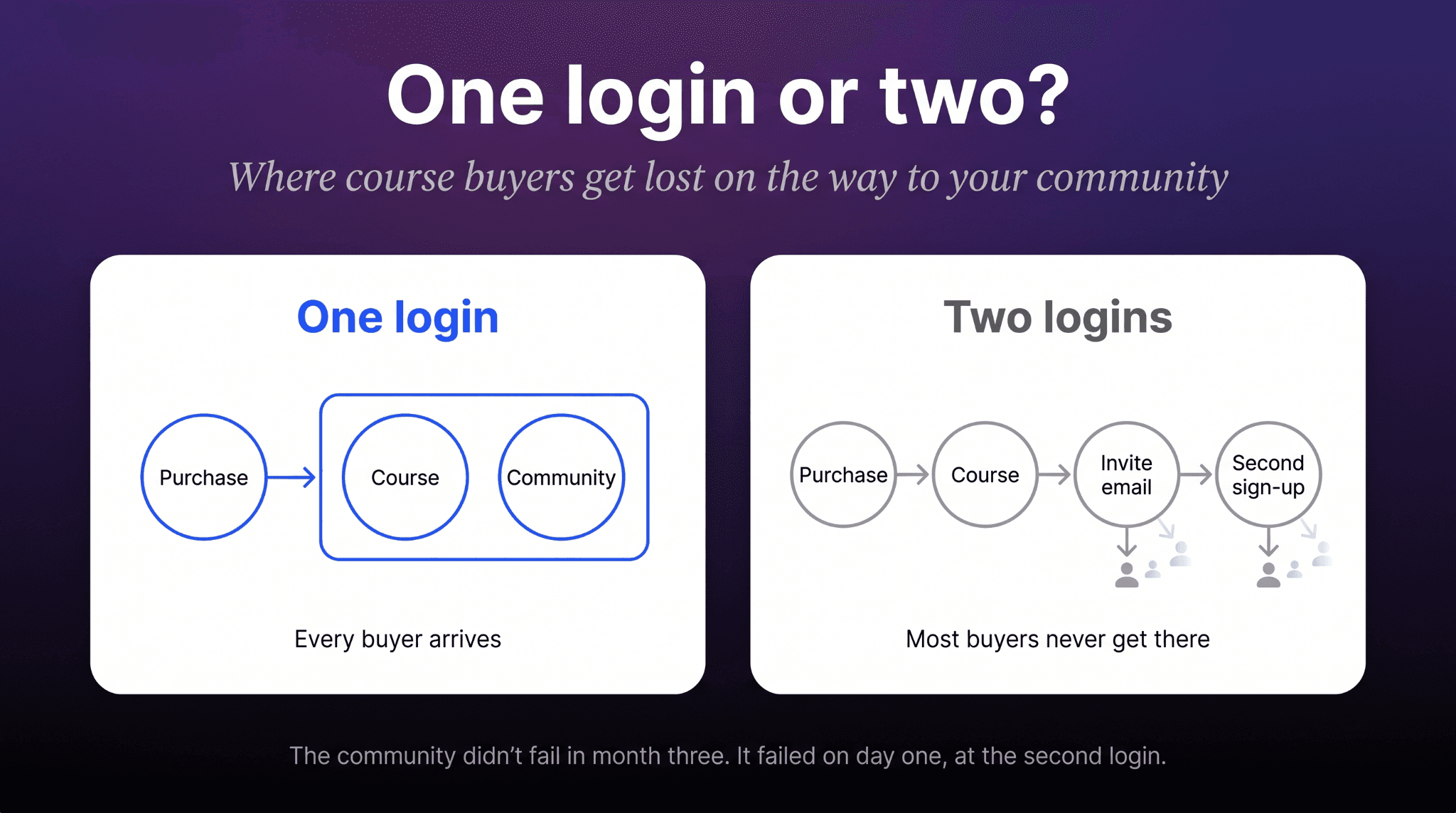
By using a platform where the community is part of the same product as the course, so the purchase enrolls the buyer in both and they see both behind one login. If the community is a separate tool, you're asking every buyer to sign up twice. Most won't.
Here's how the leak works when the community is bolted on. Someone buys your course. They get a welcome email with a link to the course and, three lines down, an invite to the community on another platform. They open the course. The invite waits. A week later it's buried under forty emails. They never join, and you never find out, because the community tool doesn't know who bought the course.
The ones who do join are the keenest ten to twenty percent. They post, they answer each other, and the room looks alive to you. Meanwhile the buyer who stalled at module two, the one who most needed a nudge, never made it in. You can't see her, because she's one record in your checkout, another in your course, and no record at all in your community.
A one-login setup has to do three things. The purchase creates the member, in the course and in the community, in the same step. Course and community live in one interface, so a buyer moves between a lesson and the discussion about it without switching tabs or tools. And the same person shows up as one record everywhere, so you can see that the quiet community member is the one who stopped at module two.
The community didn't fail in month three. It failed on day one, at the second login.
On COPE, your buyer pays, and in that moment she's enrolled in the course and inside your community. One login for both. The community comes with every account, with a feed, chat and leaderboards. Coming soon: Livestreams or scheduled events inside the community, so keep your call tool for those and post the replay in the feed.

If you want to see it with your course: set up your product and open the community that comes with it (no monthly fee)
What is the community for?
One purpose that the course alone can't deliver: accountability, feedback on work, or access to peers doing the same thing. A community without a purpose is a feed.
Pick one. Not all three, not "a space to connect." Write it as one sentence and pin it at the top:
Accountability: "This is where you post what you did this week and what you'll do next."
Feedback: "This is where you post your draft, your page, your pitch, and get it reviewed."
Peers: "This is where you find the other people building the same thing, in the same stage."
The purpose decides everything after it: what the main thread is, what you post on Monday, what a good week looks like. General chat can exist, but as a side room. If general chat is the main room, the community becomes a slower version of social media, and members already have faster ones.
A community without a purpose is a feed.
How do you run the first 90 days?
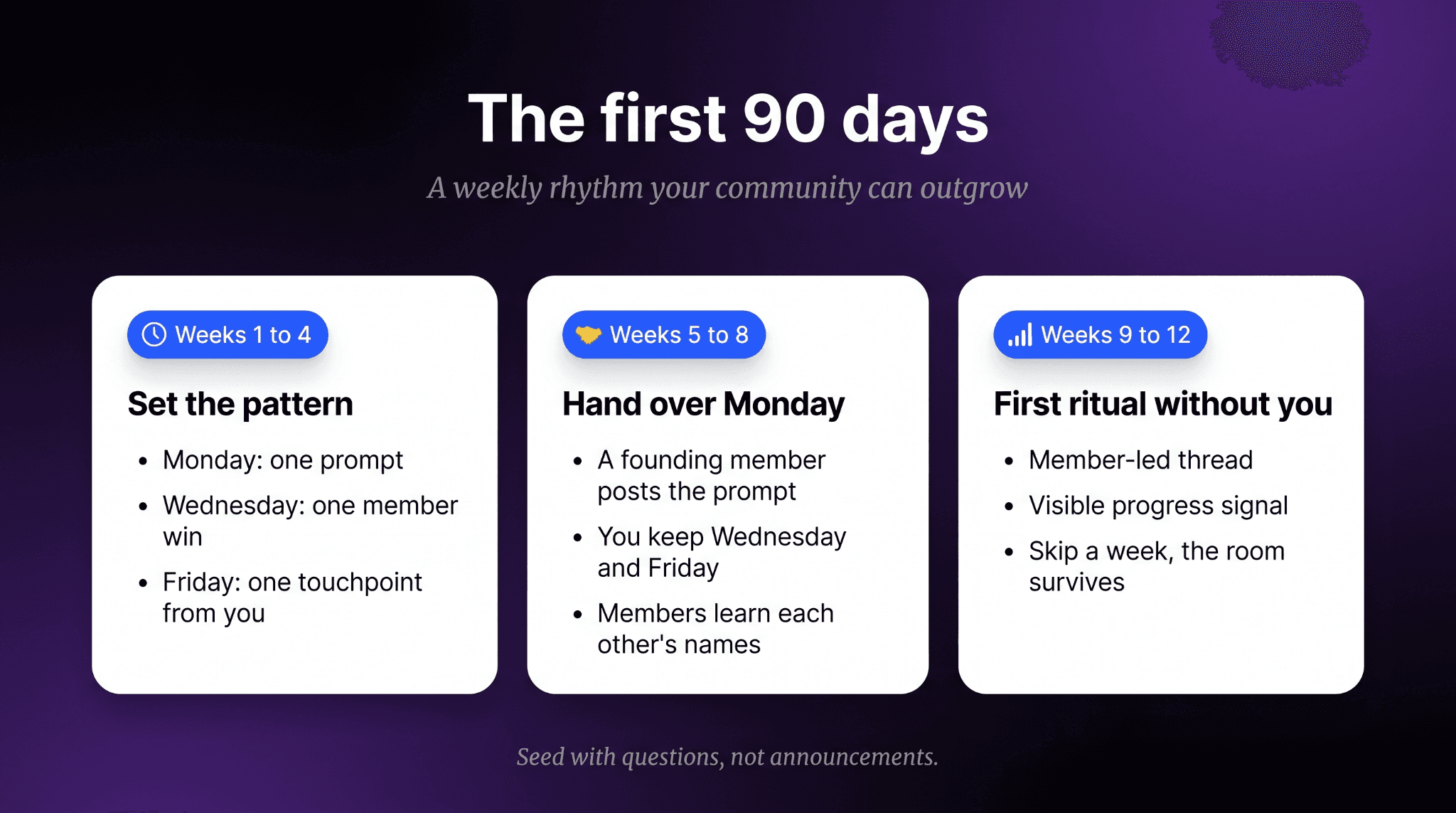
With a weekly rhythm you commit to before launch: one prompt on Monday, one member win highlighted midweek, one touchpoint on Friday. The first 90 days decide whether members believe the room is alive.
Before day one, recruit founding members by hand. Ten to twenty people from your current buyers, invited personally, asked to post in the first week. A community that opens with three posts already in it feels different from one that opens empty.
Then the rhythm, week by week:
Weeks 1 to 4: set the pattern. Monday, one prompt tied to the purpose ("What's the one thing you'll ship this week?"). Wednesday, one member win, quoted and named. Friday, one touchpoint from you: a short answer to the week's best question, a recorded walkthrough, or a live call posted afterward. Seed with questions, not announcements. Announcements get read. Questions get answered.
Weeks 5 to 8: hand over the Monday thread. Ask a founding member to post the Monday prompt. Keep the Wednesday win and the Friday touchpoint. Members start recognizing each other's names.
Weeks 9 to 12: introduce the first ritual that runs without you. Covered in the next step. By week twelve you should be able to skip a week and have the room survive it.
The guides that come out of Skool's ecosystem call the first 90 days "everything," and they're right about the timing. Where they go wrong is treating it as a content sprint you sustain forever. The point of the 90 days is to build habits that outlast your posting.
Which rituals keep a community alive without you posting daily?
Three: a member-led weekly thread for wins and blockers, a visible progress signal, and a monthly rule that something new arrives.
The member-led thread. The Monday prompt, owned by a rotating member after week five. It's the heartbeat. If nobody posts on Monday, you know by Tuesday, and you know who to check on.
The progress signal. Members stay when they can see themselves moving. A leaderboard, a "completed module" marker, a badge for finishing. It doesn't have to be gamified to the hilt, it has to be visible. On COPE, leaderboards are part of the community, so activity is visible without you tallying anything. [VERIFY: level-gating or points beyond leaderboards; if none, this sentence stays as is]
The monthly arrival. One new thing a month: a module, a template, a guest answering questions, a teardown of a member's work. Members check back when there's a reason to. A community with nothing new for eight weeks tells them the program is finished, whatever the course says.
Each ritual replaces something you'd otherwise do by hand: the thread replaces daily posting, the signal replaces manual shout-outs, the monthly arrival replaces the panic post when things go quiet.
How do you bring quiet members back, and lead them to the next purchase?
Nudge on inactivity, not on a calendar: a personal message after two quiet weeks, tied to where they stopped. And make the next offer to finishers first. A member who completed the course and got a result is your best next buyer and your best affiliate.
The nudge is one message, and it's specific: "You stopped at module two, the one on X. Most people get stuck there. Want the two-minute version of what to do next?" Not a newsletter, not "we miss you." It works because it proves you noticed, and you can only notice if the course and the community know it's the same person.
Automate what can be automated: the welcome sequence after purchase, reminders before a live touchpoint, a note when a new module lands. On COPE, customer emails for receipts, reminders and renewals go out automatically. [VERIFY: inactivity-triggered messages; if not in the register, the personal nudge stays manual, which is fine, it should be personal anyway]
Then the path forward. When a member finishes, two things should happen within a week. First, the next offer, made to them before anyone else: the advanced program, the group coaching, the next course. They've just proven the first one worked. Second, the affiliate invitation. A finisher with a result is the most credible person to recommend your course, and an affiliate program that pays them automatically turns that into a channel.
Your finishers are your next buyers and your best affiliates.
Community inside the course or beside it: Skool, Circle, Discord compared
The question isn't which community tool is best. It's whether the community lives inside the course or beside it, because that decides whether buyers arrive.
Skool makes the community the product, with gamification (points, levels, leaderboards) that gets members logging in daily. The course lives inside the community, which works well when the community is the main thing you sell. Course tools are light.
Circle is community-first with strong events and spaces. Courses exist but sit beside the community rather than inside a guided path. Good for large communities with many rooms.
Discord is free, real-time and familiar to younger audiences. No course hosting, no payments, and the second-login problem in its purest form: every buyer has to create a Discord account and find your server.
COPE puts course and community behind one purchase and one login, with feed, chat and leaderboards. No events or livestreams inside the community, so calls happen elsewhere and get posted back.
If your community is the product, Skool. If you run a large community with many spaces and events, Circle. If you sell a course and want buyers to land in a community without a second sign-up, one login is the criterion, and COPE is built around it.
You already have a Facebook group or Discord. How do you switch?
In a week, not a quarter.
Announce the move once, with a reason. "One login, next to the course, no more searching for the link."
Move the top content. Ten posts, not two hundred. The ones members still reference.
Invite by cohort. Your most active members first, personally. They seed the new room.
Post the first week's rhythm before anyone arrives. Monday prompt already up.
Leave the old room read-only for 30 days, with a pinned link to the new one. Then close it.
The members who don't come are the ones who'd already left. The ones who do are the community.
Frequently asked questions
How do I add a community space to an existing online course business? Put it behind the same purchase and login as the course, give it one purpose, recruit ten to twenty founding members by hand, and run a weekly rhythm for the first 90 days. On COPE, the community comes with every account and buyers are inside it the moment they pay.
How do I deliver an online course and a paid community from the same login? Use a platform where the community is part of the same product as the course, so the purchase enrolls the buyer in both. If the community is a separate tool, you'll lose most buyers at the second sign-up.
Does a community improve course completion rates? Most guides say yes, and the logic holds: accountability and peers keep people moving. Sourced evidence is thinner than the claims. What's certain is the reverse: a community behind a second login is used by a minority of buyers.
Should I use Discord or Facebook for my course community? Both are free and both put the community beside the course with a separate login. They work as a start and leak members over time. If the community matters to your program, put it inside the course.
How many members do I need to start a community? Ten to twenty founding members who post in the first week. Size matters less than whether the room looks alive on day one.
What should I post in a course community? Questions, not announcements. One prompt a week tied to the purpose, one member win, one touchpoint from you. Everything else is optional.
How do I keep a community active without posting every day? Three rituals: a member-led weekly thread, a visible progress signal like a leaderboard, and one new thing a month.
Can community members become affiliates? They should. Members who finished and got a result are your most credible affiliates. Set up an affiliate program that tracks and pays them automatically and invite finishers first.
A course community works when buyers land in it without a second login, know what it's for, and find something alive when they arrive. Everything else is rhythm.
COPE gives you course and community behind one purchase and one login, with feed, chat and leaderboards included in every account. Set up your course and open the community that comes with it
Verfasst von
Michelle Habenicht